Ferrari returns to suspension fairings: where Madrid seeks SF-26 gain
The upper-rear-wishbone fairing is a regulated aerodynamic surface, not new kinematics. FIA documents explain its local scale; everything else must be separated into plausible route and proof.
In Madrid's FIA document Ferrari describes the reprofiling of the rearward-leg fairing on the upper rear wishbone. The entry refers to profile, overall incidence and load distribution along the surface; its declared benefit is local. It does not declare pick-up points, linkages or kinematics: the Rear Suspension category identifies an area of the car, not permission to turn it into a mechanical change.
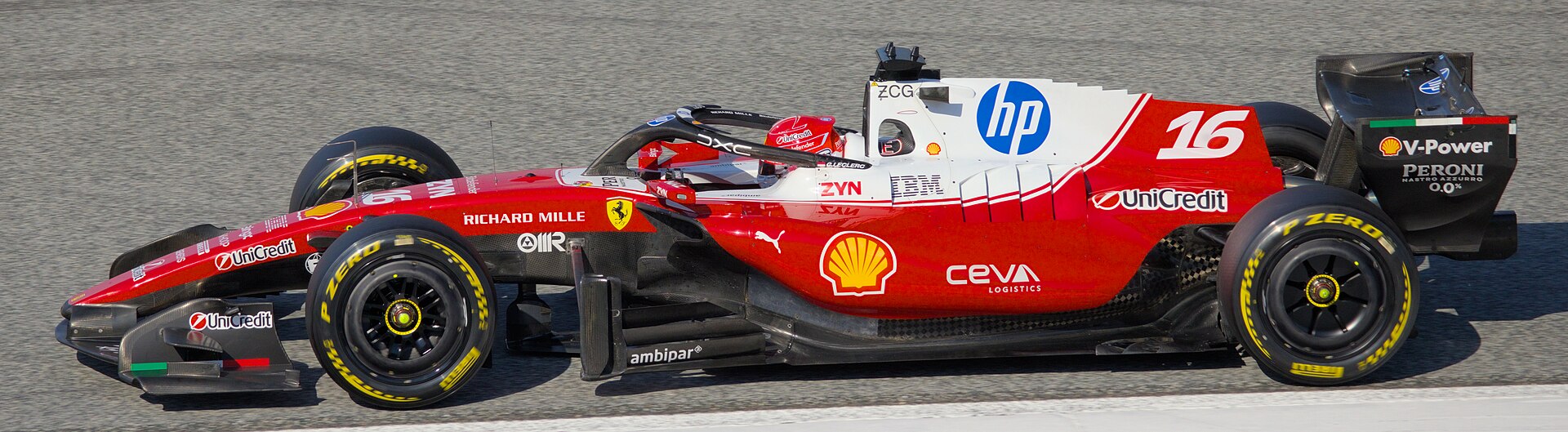
C3.17 does not leave a fairing free as a small wing: under the 2026 rules it must cover the exposed member, be rigid relative to it and respect limits on section, axis and incidence. But that is precisely why it regulates the shape meeting external airflow. The arm carries mechanical load; the cover controls how air passes around it. That is why a surface registered as suspension can seek aerodynamic load without changing kinematics.
The source says: Madrid seeks a local-load benefit by changing incidence and spanwise distribution along the fairing. At Miami Ferrari linked a revised rear-trackrod fairing, together with tail devices, to a favourable pressure gradient for the diffuser.
The engineering interpretation: a surface in the inner rear can condition flow passing between wheel, suspension, corner and downstream regions. It is therefore plausible to seek flow quality useful to the corner and, indirectly, to the diffuser or rear aerodynamic structures. Madrid does not declare that this fairing feeds the diffuser, manages tyre wake or changes wing load: those remain route hypotheses, not document facts.
The point is not that Madrid's part descends from Miami. It is more useful: Ferrari has repeatedly treated surfaces and flow around suspension as part of its rear-end work. At Miami the rear trackrod appeared in a floor-diffuser-tail package; at Monaco front fairings served a different wheel angle; at Zandvoort Ferrari declared more flow energy towards the diffuser and rear corners. Madrid returns to one rear surface. The documented thread is an area of optimisation, not a component genealogy.
There is no public Ferrari, FIA or technical-source number that isolates lap time or load from Madrid's fairing alone. Nor could an on-track result separate it from set-up, tyres, driver, track evolution and the rest of the car. The available scale is qualitative but not empty: Ferrari calls it a small update and a local load benefit. That defines declared scope; it is not a percentage, and it does not permit taking a larger package gain and assigning it to this surface.
McLaren has described rear fairings and rear-corner furniture as flow-conditioning work around corner and diffuser. Red Bull has declared fairings integrated with tail, gearbox and wheel bodywork, then a more robust gaiter and winglets downstream. Mercedes, in the available documents, records rear-corner winglets and front fairings aligned to incoming flow. This is not a ranking of solutions: it shows that the same region can be approached through the suspension member, corner elements or the wheel interface.
Comparing Section C Issue 20 of 2026 with current Issue 2 of 2027 retains C3.17 in the same family: fairings for suspension members and driveshafts, rigidity, external airflow and geometric constraints remain regulated. Know-how about profiling a permitted surface can therefore be transferable into the 2027 framework. It does not follow that Madrid's fairing is designed for 2027, nor that its shape will carry over. Resource direction depends on the whole car and the rules, not one Car Presentation entry.
Sources
- FIA — Spanish Grand Prix 2026, Car Presentation Submissions — Ferrari, Rear Suspension: upper-rear-wishbone rearward-leg fairing.
- FIA — Miami Grand Prix 2026, Car Presentation Submissions — Ferrari, front fairings, rear trackrod, floor, diffuser and tail.
- FIA — Monaco Grand Prix 2026, Car Presentation Submissions — Ferrari, front changes for wheel angle.
- FIA — Dutch Grand Prix 2026, Car Presentation Submissions — Ferrari, floor/diffuser/beam wing and work on flow to the rear.
- FIA Formula One Technical Regulations 2026, Section C, Issue 20 — C3.17 Suspension and Driveshaft Fairings.
- FIA Formula One Technical Regulations 2027, Section C, Issue 2 — Comparison with current 2027 C3.17.
- Formula 1 — Why the 2026 development race is unprecedented — Context on continuity of 2026-2027 work.
- Wikimedia Commons — Ferrari SF-26, Lukas Raich — Photo: Lukas Raich, CC BY-SA 4.0; complete metadata in demo/media.
